

As Spock (who in Star Trek lived to be 161 years old) famously spoke: “Live long and prosper” and (relating to healthcare) serving “the needs of the many”. Medtech continues to grow throughout the continuum of care. What you should expect is:
- Healthcare is pivoting from treatment to prevention
- Healthcare is generating the world’s largest volume of data
- Healthcare and tech are converging to innovate wearables
Growing up mid-last century, it wasn’t hard to embrace the giddy exuberance around flying cars (the Jetsons) to the real-time, wireless life monitoring of the Tricorder (Star Trek). Well, the future of healthcare is here and its very exciting (understatement), Today the MedTech Sector delivers on the science fiction of history. It continues to innovate and scale as the number of Boomers in retirement and life-extending technologies now available are causing the largest surge in the history of human healthcare. The numbers are equally remarkable across many metrics. However, MedTech’s influence, is and now always will, continue to be an essential, if not vital, part of life.
Every aspect of human care from birth to health maintenance and repair through life-support are becoming increasingly reliant as technology advancements extend the cycle of human life. From robotics to pharma, genetics to immunology and beyond, Medtech is thankfully here to stay.
Paragon Ventures has long and deep experience with the Medtech sector from manufacturing to asset management. Contact us for more information on the current strategic opportunities for your Medtech business.
According to CNBC’s report below, Apple CEO Tim Cook has highlighted health features as the company’s “most important contribution to mankind.” Apple’s strategy to break into the health industry, a potential $15 trillion market by the year 2030, according to RBC Capital Markets.
KEY POINTS
- Apple announced its AirPods Pro 2 headphones will soon become an FDA-cleared hearing aid.
- Adults with mild or moderate hearing loss will be able to use their Apple earphones to amplify specific sounds that they want to hear better.
- Apple has also announced new capabilities to monitor sleep and detect sleep apnea – another significant health demographic.
- The are just two examples of Apple’s strategy to plunge further into the health industry, a potential $15 trillion market.
===================================================================================
Apple AirPods Pro

Soon, people with AirPods in their ears might not be drowning you out — they might be wearing them to hear you better. Apple announced its AirPods Pro 2 headphones will become an FDA-cleared hearing aid in the coming weeks through a software update. That means that adults with mild or moderate hearing loss — about 30 million Americans, according to the Food and Drug Administration — will be able to use Apple earphones to amplify specific sounds they want to hear better.
“After you take a hearing test, your AirPods Pro are transformed into a personalized hearing aid, boosting the specific sounds you need in real time, like parts of speech, or elements within your environment,” Apple’s vice president of health, Sumbul Desai, said in the feature’s launch video.
That strategy includes developing FDA-cleared features for its wearable products and replacing what are often more expensive purpose-built medical devices. Since 2020, Apple has added a notification service for irregular heartbeats, an atrial fibrillation reader and an electrocardiogram reader to its Apple Watch, according to FDA filings.
The new feature is a free software update for some AirPods models and will be included with Apple’s $249 AirPods Pro 2.
Many over-the-counter hearing aids are much more expensive, according to buyers guides cited by the Hearing Loss Association of America, an advocacy group. While some OTC hearing aids cost as little as $99, most range from $799 into the thousands of dollars.
“What is really cool about Apple now saying their AirPods can be over-the-counter hearing aids, is we’re seeing that technology innovation at a price point and in a product that’s very mainstream,” said Barbara Kelley, executive director of the Hearing Loss Association of America.
The company doesn’t break out AirPods stats individually, but its Wearables category declined 2% annually for the most recent quarter that sales are available. Analysts say that adding health features like a hearing aid expands the market for the device, which could help sales. “The hearing aid piece is a very specific use case,” said Deepwater Asset Management founder Gene Munster, who estimates that AirPods account for about 5% of Apple’s total revenue. “It does open it up to a different market.”
How it works
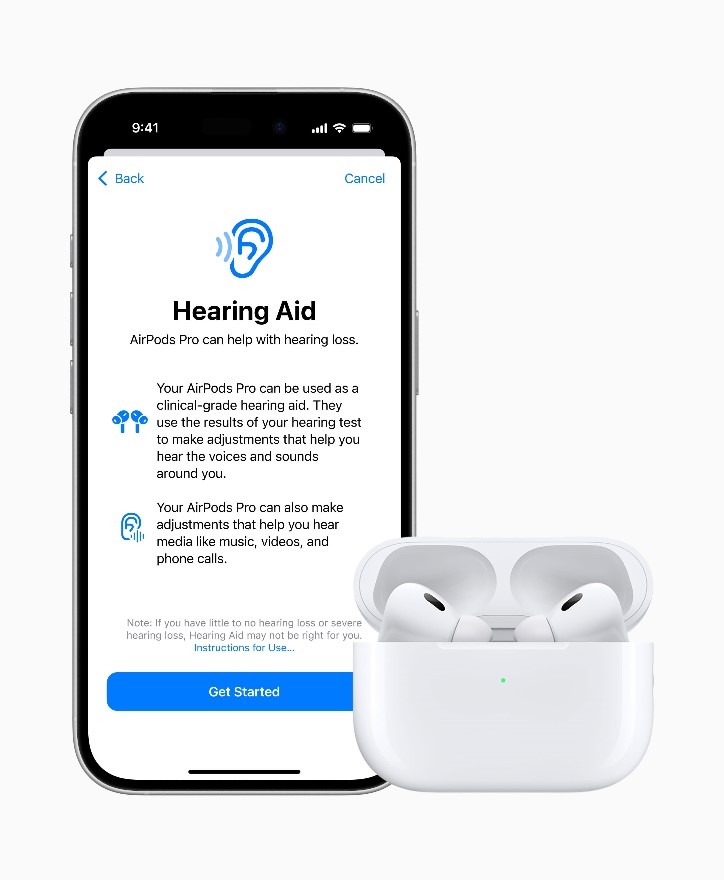
Apple’s hearing health experience requires a pair of Apple’s AirPods Pro headphones and an iPhone.
The company has built a hearing test into its devices inside the Settings app. After the program checks to make sure the headphones fit the user’s ears correctly, it plays a series of tones over about five minutes. The user has to tap the screen when or if they hear a tone.
This creates a profile of various frequencies and volume settings that the user may have trouble hearing, which are stored in the Health app. That profile can be applied to turn the AirPods Pro into personalized hearing aids.
Apple said that the test was scientifically valid and based on data it collected from its noise detection apps and a study with 160,000 participants that started in 2019.
In a promotional video, Apple showed a mom putting in AirPods to better hear her son on her birthday.
Over the counter
Apple’s launch has been boosted by a recent regulatory change. Previously, all hearing aids required a prescription after testing from a licensed audiologist. In 2022, the FDA opened up the market to over-the-counter hearing aids that were significantly cheaper due to the use of audio testing software or at-home fittings. However, Apple’s AirPods won’t immediately make other hearing aids obsolete. Among its limitations are the battery, which lasts six hours. That’s not enough for the kind of all-day wear that some OTC hearing aids can manage.
Also, the AirPods Pro are only for those with mild or moderate hearing loss, meaning people who have trouble making out speech in noisy settings. Anyone with “severe” or “profound” hearing loss still needs to see a licensed audiologist, experts said. Apple’s hearing aids were cleared by the FDA on Thursday. The agency said that Apple’s hearing test was evaluated in a study with 118 subjects in the U.S., with “comparable results” to professional fitting, and was cleared through a De Novo process that regulates medical devices without a clear predecessor on the market.
Bridget Dobyan, executive director of the Hearing Industries Association, said that she welcomed Apple’s entrance into the market to increase awareness of hearing health, but there are still many hearing loss situations that require a doctor-based approach. “OTC hearing aids may be suitable for adults with mild to moderate hearing loss, but seeing a licensed hearing care professional can also help determine unique hearing health needs,” Dobyan said. It’s not uncommon for Apple’s foray into health to draw criticism from incumbents who say the tech company’s features aren’t a replacement for actual medical devices.
For example, Joe Kiani, CEO of Masimo, a medical device company that is currently in litigation with Apple over intellectual property and trade practices, said earlier this year that the Apple Watch’s pulse oximeter feature was “masquerading” as “a reliable, medical pulse oximeter.” After a legal victory over patents, Masimo forced Apple in January to turn off the pulse oximeter on newly sold Apple Watch devices.