

 With transformational change underway across the continuum of care in the United States, many new initiatives have pointed to health care as one of the inalienable rights of U.S. citizens – the right to life, liberty, the pursuit of happiness and now affordable health care. The dichotomy of that quest and the government’s ability to fund it have created one of the most invasive and divisive initiatives of the modern era. It has also further fueled the investment community’s interest in health care while creating new opportunities and strategic options for health care providers.
The Affordable Care Paradox
It is unprecedented that health care has become such a political issue in our lives. Health care, along with its clinical and fiscal pathways, has been studied, analyzed and predicted with amazing accuracy over the past century. Long before the Affordable Care Act (ACA) implementation began, analysts found that current health care providers in the U.S. don’t have the capacity or enough resources to treat the additional masses (IE: baby boomers) joining the health care markets. However, rapidly advancing technology and pharmacology continue to improve both clinical outcomes and administrative processes. Once fully commoditized, the efficiencies created will enable health care providers to not only manage the demographic growth but also to succeed, profit and thrive.
Change Is Not New
Healthcare business owners in the current market have many options to consider as their businesses evolve to meet the challenges and opportunities presented by rapid integration of health care across both vertical and horizontal sectors. 
With tightening reimbursements, a restrictive regulatory and compliance environment and the focus on value-based-care, it is vital for health care business owners to prepare their companies for the realities of rapid growth, scale and expansion.
For acquirers of these businesses, particularly those with a preponderance of government related revenues, uncertainty has absolutely affected the M&A climate.
Any time there is proposed change that could affect revenue, growth or profitability; there will be a correlating reaction within the M&A markets. It is difficult for an acquirer to value a business whose profitability is unclear or that may be negatively impacted soon after the acquisition is completed.
Once the effects of reimbursement on profitability are known, then acquirers are able to get a better handle on valuation. There is another side to the coin. Some providers stand to significantly increase the size of their businesses as a result of growing demographics, implementation of new technologies and integration across healthcare sectors and sub-specialties. Overall, providers embracing the opportunities stand to increase revenues and profitability, if they are strategic in their implementation and abilities to scale operations.
Historically, changes in health care reimbursement-and their effects on the M&A market, go in cycles. For buyers and sellers, the key is to deal with reality and manage risk. That should be reassuring to those who are proactively managing their businesses to take advantage of the resulting opportunities.
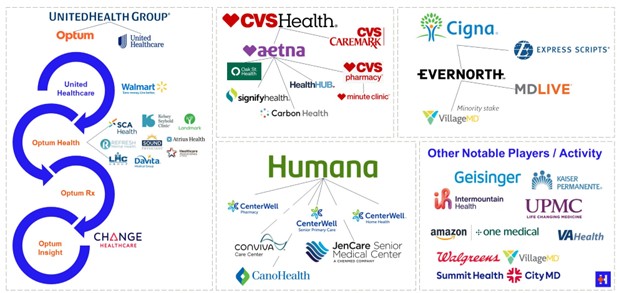
Horizontal & Vertical Integration Across Care Pathways
The Ultimate Challenge: Successful Integration
Anyone who has had the responsibility to integrate an acquisition will attest it is at best an on-going challenge to do it successfully. Adopting best practices and balancing asset demand and human capital needs can take on a life of its own.
An acquired business, which may be smaller than the acquirer’s existing business, may bring the desired synergies which led to the transaction in the first place. These synergies will hopefully improve efficiencies and outcomes for patients, payors and investors. Business 101, “Plan your work and work your plan” is a key to a successful integration.
In healthcare, both horizontal and vertical integration play significant roles in shaping the industry landscape. This includes payors, providers and pharmacies expanding their reach and service offerings including those inside facilities and into the home settings (Hospital-At-Home).
Horizontal Integration
Horizontal integration refers to the consolidation or collaboration of healthcare entities operating at the same level or within the same sector of the industry. It involves the merging or acquisition of similar organizations to expand market share, gain economies of scale, and enhance competitiveness. Examples of horizontal integration in healthcare include:
– Hospital mergers and acquisitions: Hospitals merging or acquiring other hospitals to create larger healthcare systems, add new products/services, optimize resources, and improve patient access to a broader range of services.
– Physician group consolidations: Independent physician practices joining forces to form larger medical groups or multispecialty clinics, enabling them to negotiate better contracts with payers, share resources, and enhance care coordination.
– Pharmaceutical company mergers: Pharmaceutical companies merging to consolidate research and development efforts, enhance product portfolios, and increase market presence.
Vertical Integration
Vertical integration involves the alignment or consolidation of healthcare organizations operating at different stages of the healthcare delivery process, typically along the continuum of care. It aims to improve coordination, streamline services, and achieve better continuity of care. Examples of vertical integration in healthcare include:
– Health system and primary care clinic integration: Health systems acquiring or partnering with primary care clinics to provide comprehensive, coordinated care and manage patient populations more effectively.
– Hospital and post-acute care integration: Hospitals acquiring or affiliating with post-acute care providers such as skilled nursing facilities, home health agencies, or rehabilitation centers to facilitate smoother care transitions and improve care quality.
– Insurer and provider integration: Health insurance companies acquiring or forming partnerships with healthcare providers to establish integrated health systems, enabling more coordinated and cost-effective care delivery.
Horizontal and vertical integration in healthcare are driven by various factors, including the pursuit of economies of scale, improved care coordination, enhanced patient experience, cost efficiencies, and increased market leverage. However, these integrations also raise concerns about market concentration, potential monopolies, and the impact on competition, which necessitate careful regulatory oversight to ensure the preservation of a competitive and patient-centric healthcare landscape.
Technology Advancements
Technology continues to drive healthcare more than most any other force other than the demographics, and in the future it will continue to develop in dramatic ways. While we can glimpse and debate the details of future trends in healthcare, we need to be clear about the drivers so we can align with them and actively work to ensure the best ou tcomes for society as a whole.
The future of healthcare is shaping up in front of our very eyes with advances in digital technologies, such as artificial intelligence, VR/AR, 3D-printing, robotics and nanotechnology. We have to familiarize with the latest developments in order to be able to control technology and not the other way around. The future of healthcare lies in working hand-in-hand with technology and healthcare workers have to embrace emerging technologies in order to stay relevant in the coming years.
Balancing Options and Opportunities
Every privately-held health care business ever created will, at some point, be sold, merged, bequeathed or closed. Along the way, the business owners have many options to consider as they map and execute their business plans.
The strategic options outlined below will fall into one of two categories equity options or growth opportunities. In each of the equity options, the business will be evaluated, presented and a change in ownership pursued. Strategic growth options are designed to enhance the current business operations, revenue streams and, ultimately, profitability for the business owner.
The first step is to clearly understand the strategic business plan, available resources, liabilities and stakeholders’ personal goals for the business.
Valuation
The first step in exploring your strategic options is to understand the current market value of the business. This benchmark will aid in assessing goals and setting direction for equity and growth. There are many methods used to value a health care business, and most buyers protect their strategy as part of their negotiation tactics.
EBITDA and Multiples
 The most common metric used in business valuation discussions is Earnings Before Interest, Taxes, Depreciation, and Amortization (EBITDA).
The EBITDA metric is indicative of the fiscal health and performance of the business. In valuations, a multiple is applied to an adjusted or normalized EBITDA to ascertain a valuation benchmark. This multiple can be influenced by many factors including buyer synergies, sustainability of the business model and strength of profit margins. In the early stages of exploring strategic options for your business, certain assumptions of future performance need to be assessed. These assumptions, primarily around scale and volume, need to be carefully analyzed and be realistic and achievable. While a new contract or referral source may promise access to substantial new revenue, the business capacity, scale and margins need to also be evaluated. Once you know what you have and what it’s worth, you can begin exploring the strategic options for your business.
Selling Business Equity
At some point, most business owners look to reap the rewards from the many years of hard work through a sale of their company. The reasons why a business owner may seek a sale are many, and the most common are retirement, strategic positioning or wealth management. In order for a strategic sale transaction to consummate, a business needs to be properly prepared in advance.
Each of the business’ critical components, ranging from revenue and referrals to employees, contracts and operations, must be critically evaluated and assessed. Comparable transaction analysis and live market assessment will then confirm and reinforce the business valuation. From this vantage point, a business owner will have an eagle-eye view of how the business will perform in the current market. This performance assessment is important to match the owner’s expectations and goals with the realities of valuation from a sale.
Growth Acquisitions
It is often more difficult to grow organically, and it takes a lot longer to get to the same scale than if you were to strategically acquire a company… the right company and at the right time. A business owner considering growth acquisitions needs to be informed of the inherent risks and rewards associated with integrating a new business into their existing operations.
It is critical to remember to “protect the mother ship.” Even the best acquisition, improperly implemented, can disrupt cash flow and negatively impact valuation. A strategic acquisition with well implemented integration can be nicely accretive to earnings and provide expansion and valuable synergies for the buyer.
Recapitalization
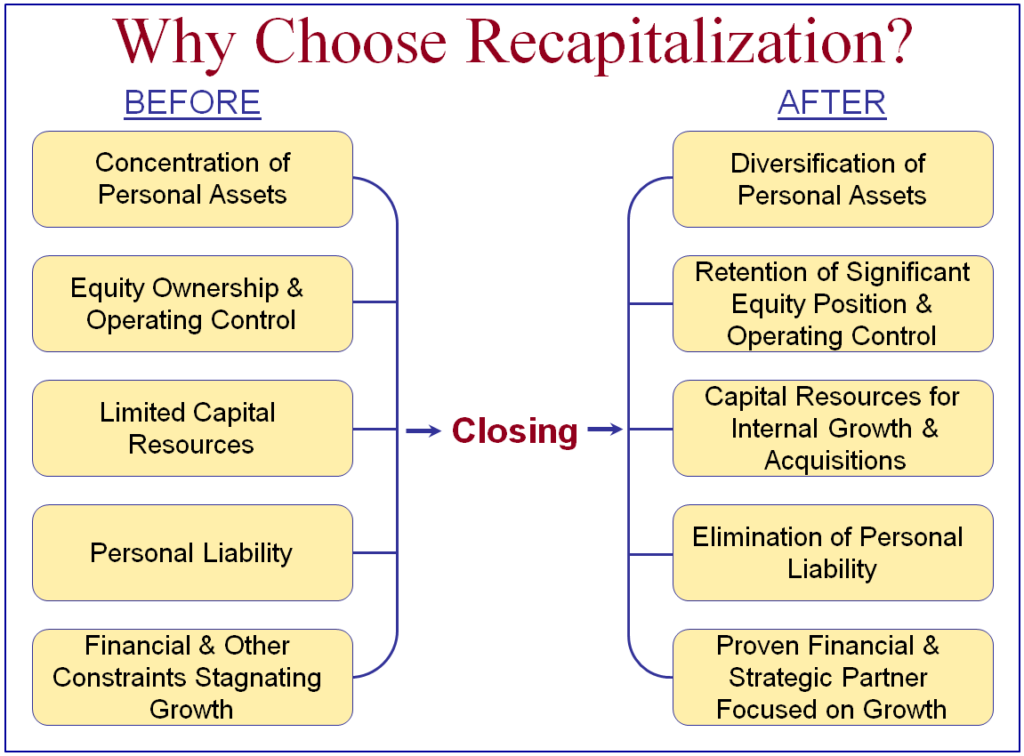 This simply means that value and equity ownership are being shifted within your company. Typical objectives might include reducing debt, generating liquidity for shareholder(s), raising cash to fund growth or a combination of all three.
By taking some, but not all, of your investment off the table today and reducing the financial leverage of the business, recapitalizations allow you to benefit from future growth with much less personal risk.
Typically, recapitalizations are offered by private equity firms or “sponsors” with access to committed capital and vast expertise in finance and business management. Often these firms bring operating synergies and significant relationships which can enhance the growth trajectory, profitability and valuation of the recapitalized business. For the business owner, a private equity transaction can offer a second bite of the apple after the next stage of grow in the business.
Accelerating Growth
Every business owner should be focused on their growth options on a daily basis. The decisions you make to pursue new revenue, maximize efficiencies and hurdle challenges will ultimately effect the valuation of your business and your strategic equity options in the future.
When assessing growth options, not unlike considering acquisition opportunities, it is important to “protect the mother ship.” You have worked hard to build and grow your business, and you need to make certain the growth initiatives are accretive to the enterprise.
There are many growth options you may consider, and each needs careful analysis along with realistic assumptions and projections. Traditional growth options include new geographic expansion, negotiating new payor contracts, adding fresh product lines and improving marketing penetration.
 Other growth options have emerged since the advent of ACA, the integration of horizontal healthcare sectors and other healthcare initiatives. These include opportunities to expand and scale your business through telehealth, retail offerings, social networking and private concierge care. In some circumstances, a provider may look to participate in closed contracts through subcontracting or joint venture arrangements. However these arrangements require an extra degree of caution and careful execution as the impact can be far reaching and impact future strategic equity options.
Future growth options will likely include components of population-based healthcare initiatives. Any population based care involves a new way of seeing the masses of individuals seeking health care-looking at patients not just as individuals but also as members of population groups. This approach does not detract from individuality but rather adds another dimension, as individuals benefit from guidelines developed for respective populations.
As the healthcare industry enters a new era marked by transformational integration and consolidation, organizations must embrace strategic initiatives that prioritize patient care, leverage technological advancements, optimize operations, and address the evolving needs of communities. By navigating this landscape with foresight, collaboration, and a commitment to excellence, healthcare entities can position themselves at the forefront of positive change, delivering enhanced value to patients and stakeholders alike.
If you are considering the sale, merger or recapitalization of your healthcare business, contact us at Paragon Ventures. We can help you prepare, explore, and when the time is right… execute the strategic options available in the current market. 800-719-1555 or email: jsadock@paragonventures.com