
“When the Owner IS the Business: How Owner Dependence Can Impact or Waylay Deals”
A business that cannot survive without its owner suffers from high “owner dependency,” also known as “key person risk” or “founder dependence”. For a buyer, this level of dependency is a potential major liability that can jeopardize a deal entirely or force a significant price reduction.
This problem is common in small businesses where the owner is the primary rainmaker, decision-maker, or holder of all institutional knowledge. During the due diligence phase of an acquisition, a buyer will scrutinize the business’s operations to determine if it can run effectively without the owner.
In the lower middle market today, business owners are in a strong position: there is a large amount of private equity “dry powder,” motivating buyers to deploy capital. However, a critical vulnerability in many deals is owner dependence — i.e., when the business relies heavily on the founder/owner in ways that threaten continuity or value in a sale.
When the owner is essentially the business — meaning that customers, operations, or relationships hinge on the owner’s involvement — that dependency increases risk in an M&A transaction. Buyers (especially financial sponsors) will discount value or walk away when they see that the business would flounder without the owner’s continued presence.
As a result, sellers (or advisors) must proactively reduce or mitigate dependency — through organizational design, systems, staff, and processes — well in advance of a deal. Is there an heir apparent in your business? Someone who can take over the day to day operations and management, perhaps by structure or design?
 Broader Market Trend
The backdrop is a bullish capital markets environment, with many buyers actively seeking acquisitions. But this favorable context does not shield deals from failing due to structural vulnerabilities like owner dependence.
Early Assessment & “Dependence Audit”
Before even considering a sale, owners (and their advisors) should evaluate which parts of the business are overly reliant on the owner — e.g. key customer relationships, specialized knowledge, or sales lead generation.
Build redundancies: hire or promote staff who can take over crucial functions, document workflows, and reduce concentration and owner dependency.
Transition Period / Earn-outs / Retention Incentives
In transactions, there are structure mechanisms to bridge the transition risk — for example, seller-side earn-outs, retention bonuses for critical employees, or phased handover/transition periods. Expect that buyers may adjust their valuation downward (or demand stricter representations and warranties) when dependence is high. In extreme cases, dependence may kill a deal entirely.
Being able to tell a consistent story of how the business will run without the founder (or with less founder input) improves buyer confidence and helps maintain deal momentum.
The problems created by owner dependency
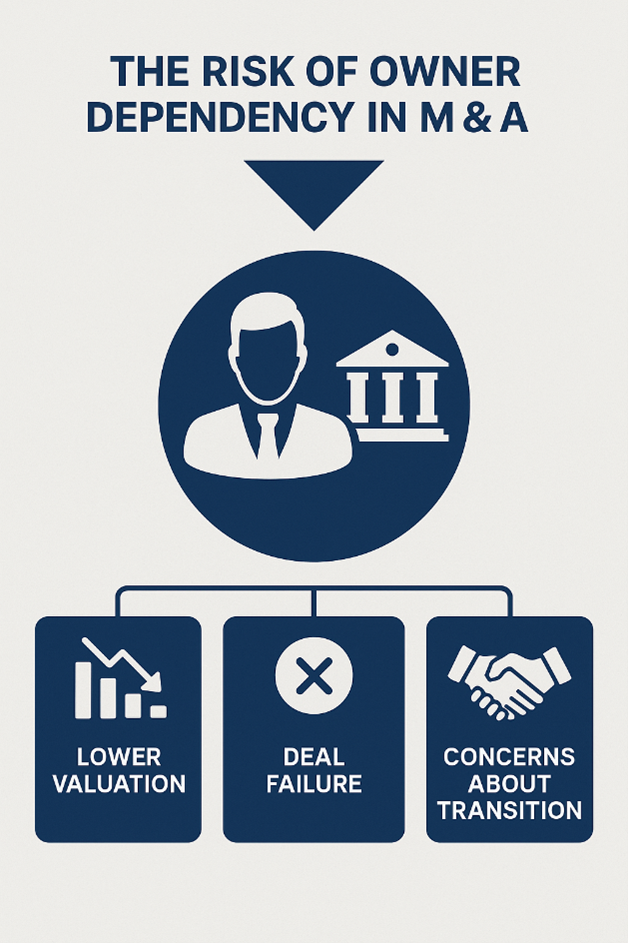
- Reduced valuation: The primary consequence of owner dependency is a lower sale price. This is a direct reflection of the risk that the company’s performance will decline sharply after the owner’s departure.
- Operational risk: A buyer may discover that the owner is the linchpin for key functions, such as sales, product development, or vendor relationships. The fear is that this institutional knowledge will leave with the owner, causing significant disruption.
- Difficult transition: The sales process can be long and complicated if the owner is needed to train a replacement or transition key relationships. To mitigate this risk, buyers may require a multi-year “earn-out” period, which makes a portion of the purchase price contingent on the company’s future performance.
- Failed deals: If the business’s dependence on the owner is too great, a deal may fall apart completely. Buyers want to acquire a sustainable business with a clear future, not just a job for the current owner.
How owners can reduce dependency and maximize sale value
For business owners preparing for an exit, the solution is to make the business run more independently of them. This can significantly increase its value and marketability.
- Document all processes: Create detailed standard operating procedures (SOPs) for every major business function so that institutional knowledge is no longer “in the owner’s head”.
- Build a management team: Groom and empower a second tier of leadership to handle day-to-day operations. This creates a succession plan and shows buyers the business is resilient.
- Diversify relationships: The owner should not be the sole point of contact for key customers, vendors, and employees. Other team members should develop these relationships to maintain continuity.
- Focus on strategic, not tactical, work: Transition the owner’s role from being involved in daily tasks to focusing on high-level strategy. This proves that the business can operate smoothly without the owner’s constant oversight.
- Rebrand if necessary: For businesses named after the founder, re-branding can help shift the company’s identity from a personal one to a brand-centric one.
- Partner with experienced advisory: An experienced M&A advisor can help the business owners to recognize not only owner dependency but also other factors that may impact valuation or the transaction structure and help ensure surety of closure in a transaction.
Get Prepared For A Successful Transaction
For more information and a confidential discussion on the valuation and strategic options for your healthcare business, contact us at Paragon Ventures – 800-719-1555 or email: partners@paragonventures.com