
Part One – Preparing for M&A
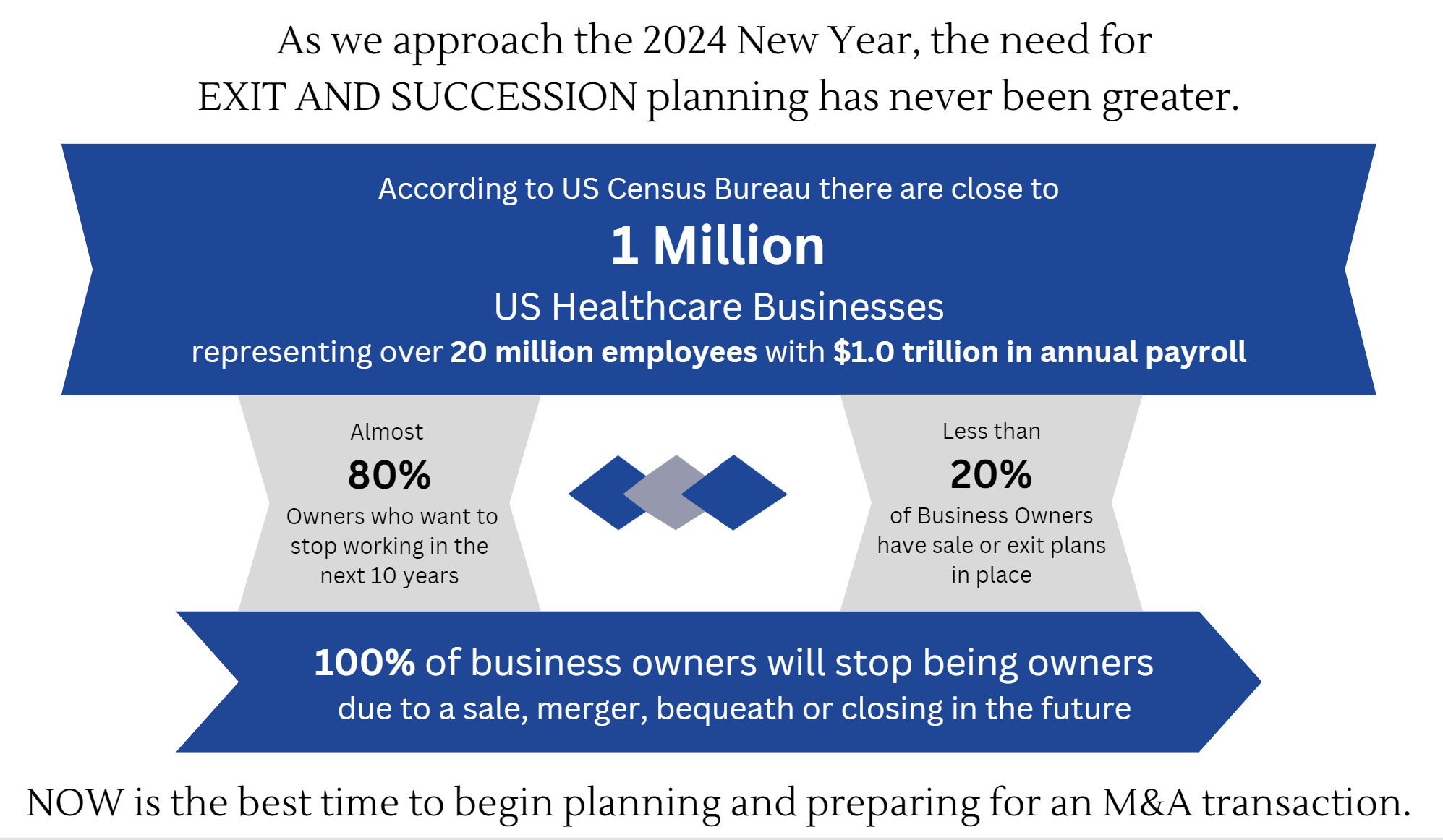
These are significant numbers indeed. Given this information, every healthcare business owner should have a clear understanding of their business, the sale, merger or acquisition process and a plan to accomplish their personal and professional goals. There are many strategic options that could be considered:
- Sale, Merger or Recapitalization: The sale of equity in your business can be a life changing event and the culmination of a successful business lifecycle. M&A should be approached cautiously and with a clear plan and process in place to maximize the value and provide significant surety to close.
- Growth & Expansion: With such a large number of healthcare businesses, there could be acquisition opportunities for growth. This could involve acquiring smaller businesses, merging with similar-sized ones, or even expanding into new markets.
- Diversification: Given the broad spectrum of the healthcare sector, there might be unexplored areas that present viable business opportunities. For example, if the business is predominantly in the hospital sector, it might consider venturing into home healthcare or telemedicine.
- Investment in Technology: The healthcare sector is rapidly evolving with the advent of new technologies. Investing in digital health solutions, AI, or machine learning could give the business a competitive edge.
- Partnerships and Collaborations: Forming strategic partnerships or collaborations with other healthcare businesses, payors and vendors could provide mutual benefits and open up new opportunities.
- Sustainability initiatives: With the increasing emphasis on sustainability and social responsibility, businesses could consider initiatives that not only benefit the environment but also improve their public image and potentially attract new patients, referral sources, Vendors and customers.
Please note that these strategic options should be explored with discretion and confidentiality. A merger and acquisition advisor can provide the guidance needed to manage these strategies effectively and proactively. This also helps ensure the business owners can continue to focus on the smooth running of the business.
M&A Step One: Getting Ready To Be Ready
Start Early and Stay Proactive: Preparation for an M&A transaction should begin well in advance. Starting early allows you to identify and address potential financial issues, ensuring that your financial statements are accurate, up-to-date, and reflective of the company’s true value. Proactivity is a hallmark of successful M&A preparation.
Establish Transaction Goals
 Establishing transaction goals in healthcare mergers and acquisitions (M&A) is a critical step that requires careful consideration of various factors. These goals should align with the overarching strategic objectives of the organizations involved and the personal goals of the business owners & stakeholders.
- Define Strategic Objectives: Clearly articulate the strategic objectives of the healthcare organizations involved. This could include goals such as improving patient care, expanding service offerings, entering new markets, or achieving cost efficiencies.
- Assess Financial Considerations: How much do you want for the business in a sale? What transactional structure would meet your fiscal objectives? Understand the tax implications with an experienced M&A tax advisor. Evaluate the financial health of your business to achieve these goals. Assess any cost synergies, profitability, and ways to enhance financial performance through a transaction. Consider how the merger or acquisition will impact the balance sheet, income statement, and cash flow post-closing.
- Conduct a SWOT Analysis: Perform a comprehensive Strengths, Weaknesses, Opportunities, and Threats (SWOT) analysis. Identify the unique strengths that can be leveraged, weaknesses that need addressing, opportunities for growth, and potential threats. Address each of these proactively.
- Evaluate Operational Efficiencies: Identify opportunities for operational improvements and efficiencies. This may involve streamlining processes, optimizing resource utilization, and integrating systems to enhance overall operational performance in a combined or stand-alone basis.
- Address Regulatory and Compliance Requirements: Given the highly regulated nature of the healthcare industry, it’s crucial to establish goals related to compliance with healthcare regulations. Ensure that the transaction complies with legal and regulatory requirements, and establish a plan for addressing any potential challenges.
- Enhance Clinical Quality and Patient Care: If improving patient care is a key objective, set specific goals related to clinical quality. This could involve implementing best practices, standardizing care protocols, and leveraging combined resources to enhance overall patient outcomes.
- Develop a Cultural Integration Plan: Recognize the importance of organizational culture in healthcare. Establish goals related to cultural integration.
- Address Workforce Transition: Clearly define goals related to workforce transition, including staff retention, role adjustments, and talent management strategies.
- Plan for Technology Integration: Develop goals for integrating healthcare information technology systems. This includes electronic health records (EHRs), data management, and other technology platforms of the business. The integration should enhance interoperability and support collaborative care.
- Risk Mitigation: Identify potential risks associated with the transaction and establish goals for risk mitigation. This could involve creating contingency plans, addressing legal and regulatory risks, and ensuring a smooth transition for patients and stakeholders.
By carefully considering these factors and aligning transaction goals with the broader strategic vision, healthcare organizations can increase the likelihood of a successful merger or acquisition while delivering positive outcomes for patients, staff, and the community.
Assemble Your M&A Team
 Embarking on a merger or acquisition (M&A) journey is a complex and multifaceted process that requires careful planning, strategic thinking, and the right team to navigate the challenges. Assembling a high-performing M&A team is crucial for success, as each member (advisors, accountants, tax and legal experts) brings a unique set of skills and expertise to the table.
External advisors, such as investment bankers, consultants, and M&A advisory experts, bring a professional and experienced perspective and intimate industry knowledge to the M&A team. Their expertise can provide valuable insights into market trends, valuation methodologies, and negotiation strategies.
Assembling a successful M&A team is a strategic imperative for organizations seeking to navigate the complexities of mergers and acquisitions. By carefully selecting key players with diverse skills and expertise, organizations can enhance their ability to execute a seamless and successful M&A transaction. The collaborative efforts of these professionals, guided by effective leadership and communication, lay the foundation for a smooth transition and the realization of synergies in the post-acquisition phase.
Developing A Sale Strategy
 Developing a successful M&A sale strategy is a multifaceted process that demands strategic thinking, attention to detail, and collaboration across various functions. Whether seeking a full exit or a growth / expansion plan, a successful transaction requires clear goals and objectives, a strategic plan and careful execution.
In the dynamic landscape of business, mergers and acquisitions (M&A) have become integral for some companies seeking growth, market expansion, or strategic realignment. Successfully navigating through the complexities of M&A requires more than financial acumen; a well-thought-out sales strategy is crucial to ensure a smooth transition and capitalize on the new opportunities. Paragon Ventures M&A Series will guide you through the essential steps in preparing an effective M&A sales strategy.
- Understand Your Value Proposition: Before diving into the M&A process, it’s vital to have a clear understanding of your company’s unique value proposition. What makes your products or services stand out in the market? How can the merging or acquiring entity benefit from this uniqueness? Identify key selling points that can be highlighted during negotiations and integration.
- Conduct a Thorough Market Analysis: A robust market analysis is the foundation of any successful M&A sales strategy. Evaluate market trends, customer behavior, and competitive landscapes. Understanding the target market’s needs and pain points will enable you to align your sales approach with a buyer or investor’s objectives.
- Customer Retention Plan: One of the challenges in M&A is retaining existing customers during the transition. Develop a customer retention plan that emphasizes continuity, reassurance, and communication. Address concerns promptly, and highlight the benefits of the merger or acquisition to your customer base. Do your vendor and payor contracts address assignability in the case of a sale or merger?
- Team Integration: A successful M&A sales strategy involves seamless integration not only of systems and processes but also of teams. Develop a plan to integrate sales teams, aligning them with common goals, and fostering a collaborative culture. Effective communication is key to easing any potential tensions and ensuring a unified front during customer interactions post-closing and during transition.
- Define Key Performance Indicators (KPIs): Establish measurable KPIs to track the success of your M&A sales strategy. This could include customer retention rates, revenue growth, market share expansion, and more. Regularly evaluate these metrics to make data-driven adjustments and ensure the strategy’s effectiveness.
What types of transactions are you interested in closing? At what valuation? What is your preferred structure? What is the timeline you desire to complete the transaction? A well-executed M&A sale strategy not only maximizes financial returns but also paves the way for a smooth transition, setting the stage for the continued success of the combined entities. A well-prepared M&A sales strategy is essential, early step for maximizing value and ensuring a successful closing of a merger or acquisition transaction.
Next up in this PV M&A Series: Gathering Company Information and Preparing Financials